APEA, African Preservice Education Association
About APEA

An action-oriented think tank for Africa's pre-professional pipeline.

APEA provides policy, research and technical consultancy for whole-system education change, human capital development and sector alignment across Africa.

Executive summary

What APEA is

  • An action-oriented think tank and the operational arm of the Pedagogical Science Institute (PSI).
  • Policy, research and technical consultancy for whole-system education change, human capital development and sector alignment across Africa.
  • Work across the entire pre-professional pipeline: learners, students, apprentices and graduate trainees, the educators who prepare them, policymakers, and industry in energy, technology and economic development.
  • Evidence-based policy frameworks, commercially viable intellectual property and accredited training at scale.
Our mandate

Systemic change across the whole human capital pipeline.

60%+of Africa's population is under the age of 25
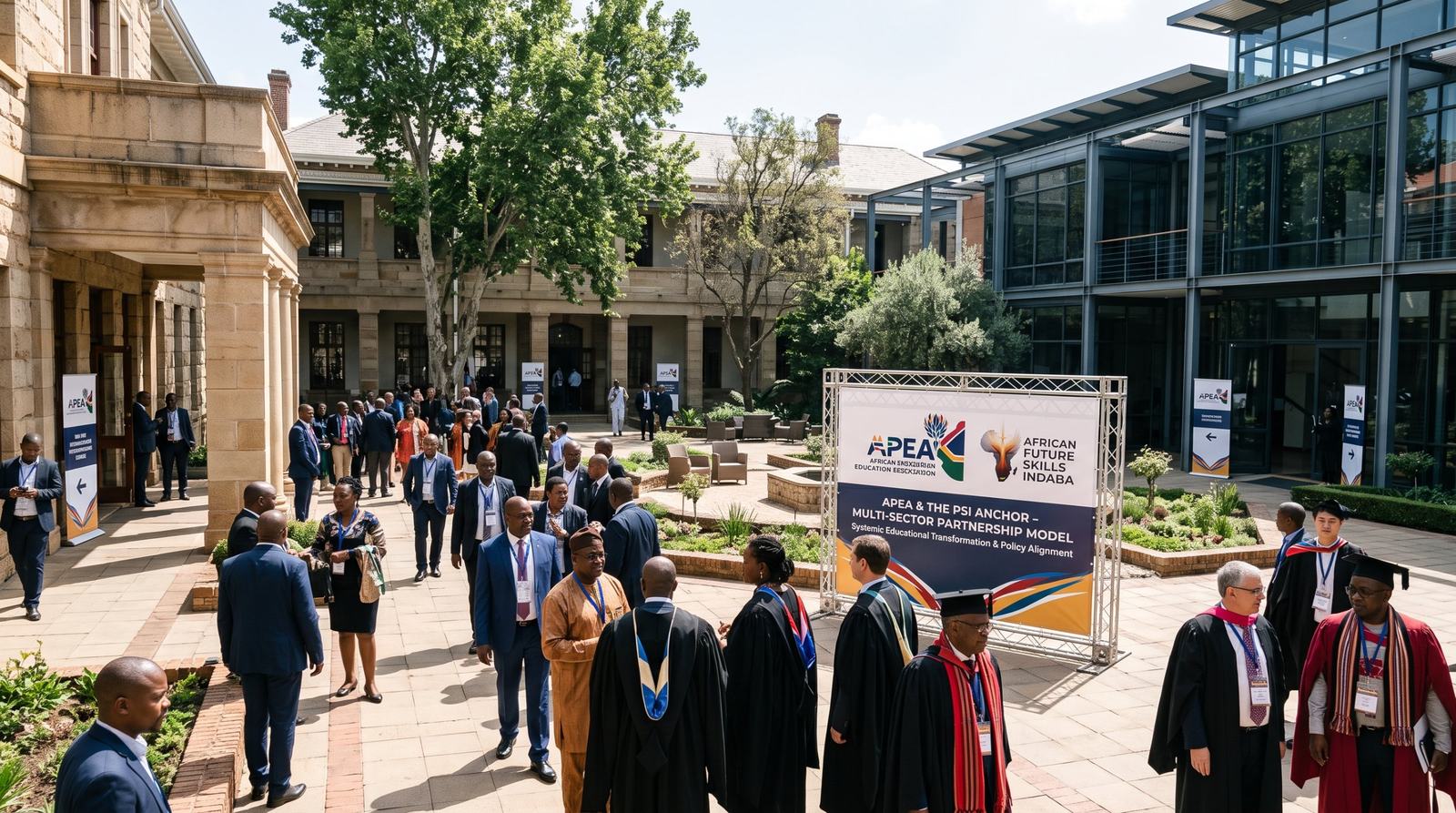
Academics and partners gathering in a university courtyard

APEA's principal object is to operate as an action-oriented think tank and the strategic operational arm of the Pedagogical Science Institute (PSI). We provide high-level policy research, technical consultancy, accredited training and curriculum development, aimed at systemic educational transformation, specialised human capital development and sector alignment across the continent.

Africa's youth are its greatest asset, and its greatest risk if the skills gap goes unanswered. Unemployment is high, and what education systems teach often fails to match what the global economy, the Just Energy Transition and the Fourth and Fifth Industrial Revolutions demand.

So we work beyond traditional education silos, with solutions for the entire pipeline: educators, pre-professional youth, policymakers, and industry in energy, technology and economic development.

EducatorsPre-professional youthPolicymakersEnergyTechnologyEconomic development
Our definition
Preservice education is the formal education and training people receive before they enter the workforce as full-time professionals, in any field.

Teachers are one part of that pipeline, not all of it. That's why a preservice association convenes ministers, investors, employers and creative studios.

LearnersStudentsApprenticesInternsGraduate traineesEducatorsEmployers
The problem

Four gaps APEA was set up to close.

01

The skills and jobs mismatch

Africa will need over 3 million new green workers by 2030, and 40% of those roles need specialised or advanced skills that today's systems are not producing.

3M+ direct jobs in 12 sub-sectors; up to 1.3M specialised and advanced roles.

02

The technological and digital divide

Access is growing faster than the skills to use it, in AI, robotics and advanced manufacturing.

230 million jobs in sub-Saharan Africa will need digital skills by 2030 (IFC).

03

Climate and energy urgency

Energy and power alone account for about 70% of forecast green jobs, led by solar at up to 1.7 million.

Africa produces 3% of global emissions; over $100bn a year in green investment is needed.

04

The policy and implementation gap

Governments hold strategies such as AU Agenda 2063 but lack the local research and capacity to turn them into funded programmes.

Five countries hold up to 720,000 of the 2030 jobs, so national plans matter.

Sources: Forecasting Green Jobs in Africa, BCG, FSD Africa and Shortlist (2024); IFC, Digital Skills in Sub-Saharan Africa (2019).

The PSI anchor

As the operational arm of the Pedagogical Science Institute, APEA's work feeds directly into policy.

Integrated, not scattered

The seven pillars link technology with decolonisation, and economic development with climate action.

R.I.S.E. values

Resilience, Innovation, Service & Collaboration, Excellence.

Work with us

Bring APEA into your next reform, programme or partnership.